

Published
The argument against car ownership is compelling and compounded by increasingly concerning statistics. Cars are a major factor in climate change, accounting for 34% of nitrogen dioxide in the atmosphere. They are also a health concern: the ground level ozone caused by nitrogen dioxide apparently contributes to the premature deaths of 9,500 people per year in London alone. Vehicles create noise pollution, dominate our built environment, and threaten safety and well-being.
When Transport for Quality of Life was commissioned to identify the changes needed to enable the UK is to deliver its share of global emissions reduction, it concluded that by 2030 traffic must be reduced by 20-60%, depending on the speed of both the switch to electric vehicles and the extent to which the electricity powering them is decarbonised.
Planning policy is adapting to discourage car use. The National Planning Policy Framework states that, ‘Planning policies and decisions should support development that makes efficient use of land, taking into account… the scope to promote sustainable travel modes that limit future car use’.
As is often the case with environmental and health concerns, society is ahead of policy: we are apparently beyond ‘peak car’. This is led by declining car use among millennials and urbanites. In the 1990s, 80% of UK residents were driving by the age of 30, whereas today this figure is not reached until the age of 45. Car-sharing is becoming increasingly popular, with Uber used by 3.6 million regular passengers in London alone.
Blenheim Strategic Partners understands the significant harm that unnecessary car use can cause; but we also appreciate that a car is often a necessity. And so mindful of the need for a gradual approach to reduced use, we offer sustainable alternatives in the form of active travel; we incentivise the transition away from car dependence through enabling car clubs and car sharing, and we provide ample electrical charging points.
Furthermore, our newest communities are planned around a unique approach to car parking which aims to create largely car-free communities, without compromising choice.
Car-free neighbourhoods are not new: Venice has been car-free since the 10th century BC. More recent examples exist throughout the Netherlands, Denmark and Germany where car-free residential developments have increased by 33% those who cycle to work, which compares to just 2.8% in the UK.
Low-traffic neighbourhoods (LTNs) are increasing in the UK, partly in response to lockdowns and the growing popularity of the ‘15-minute neighbourhood’. LTNs, of which there are several in London, are inspired by Dutch urban planners, who refer to ‘unbundling’ as a means of removing motor traffic from walking and cycling networks.
Unbundling is precisely what Blenheim Strategic Partners plans to implement at Hill Rise in Woodstock, following planning consent in spring 2022. Our pioneering approach is intended to benefit both the environment and community development.
We understand that reduced parking can have a detrimental impact, leading to and the use of pavements and front gardens for car storage and penalising those with mobility problems. And we are fully aware that for many, the car and the user’s close proximity to it represents safety, freedom, flexibility and independence.
So our innovative approach focuses on the ‘evolution’ towards a lower traffic neighbourhood, a gradual approach ultimately determined by the residents themselves.
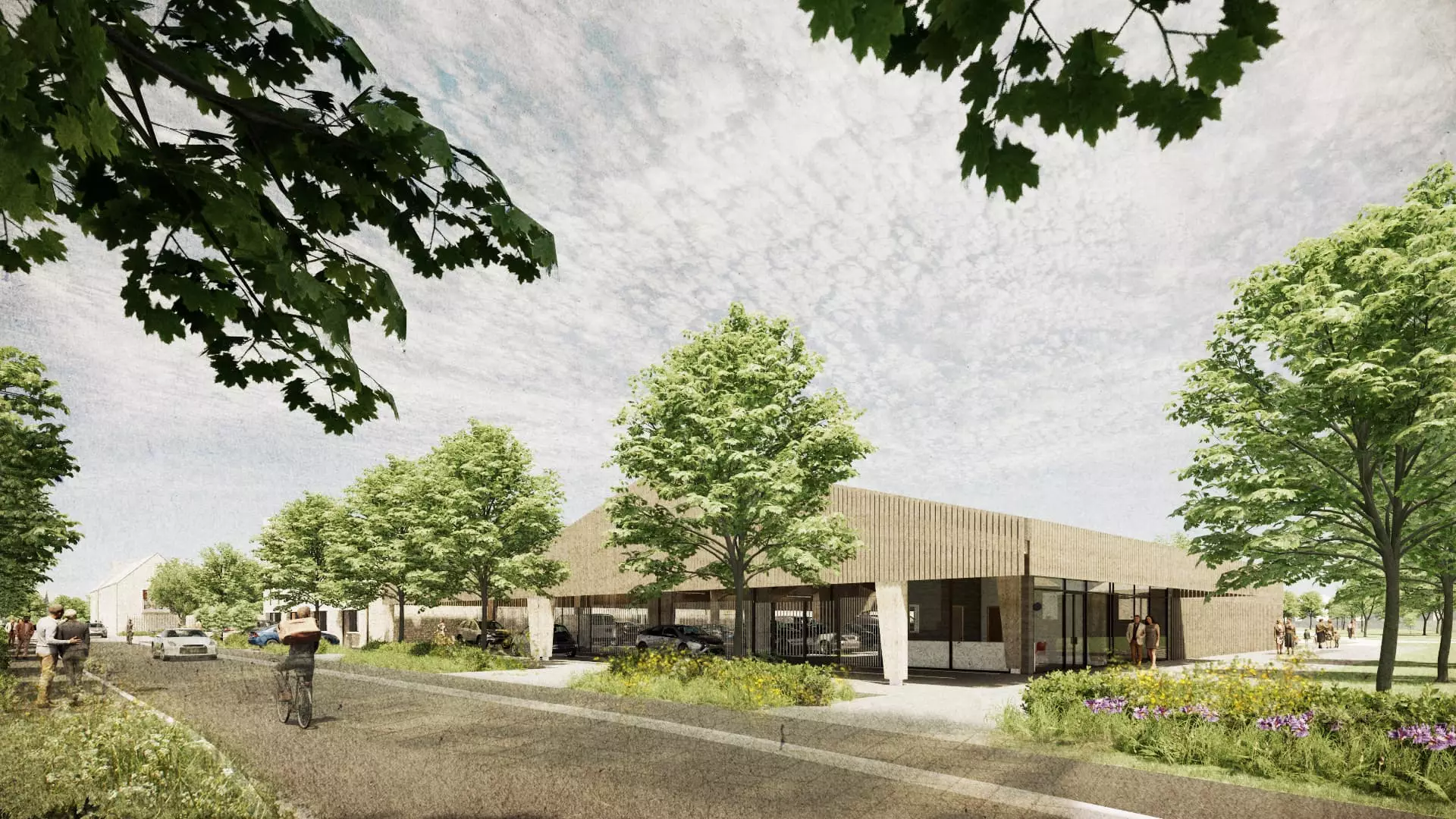
Hill Rise will feature parking barns: flexible spaces which will serve, initially, as car storage, with electric chargers and space for car club use – but also as an e-commerce collection point and e-bike hire, among other community services. Gradually the parking barns will adapt, ultimately existing solely for community use.
With the benefit of research and insight from built environment experts, we have envisioned a timeline which tracks the decline of the privately-owned car and adapts the approach to parking at Hill Rise accordingly.
Our modelling assumes that, initially, a majority of residents will be car-users. They can use on-plot parking within the footprint of their homes, the shared private parking courts included throughout the community or the two parking barns.
After five years we predict that one in ten households will have just one car. They may have converted their on-plot parking into garden ‘rooms’, studios or workspaces. Parking courts, now less in demand, might be developed as food gardens or as a Library of Things where residents can rent practical equipment. Over perhaps three decades, the requirement for parking may be reduced to such an extent that the barns themselves will evolve to host a home-working hub, pop-up events, a gym or exercise studio.
This proposed approach recognises that there is no single solution to car parking and that flexibility must remain.
It also envisages a low-traffic community – ultimately a no-traffic community – which will feature safer and more inclusive streets, low levels of air and noise pollution, better opportunities for walking and cycling and attractive open spaces. As car use is reduced, residents will see an increase in such benefits, including new opportunities for natural biodiversity, play areas and outdoor resting spaces - a strong incentive to embrace this evolution.
Blenheim Strategic Partners takes a long-term approach to creating communities, partially inspired by the past. We are mindful that it was only during the twentieth century that the car dominated the streets: original village layouts are natural LTNs. So, as we navigate the decline from peak-car, it is appropriate and timely to re-invest in the advantages that LTNs can bring, and we are pleased to assist our residents in doing so.